



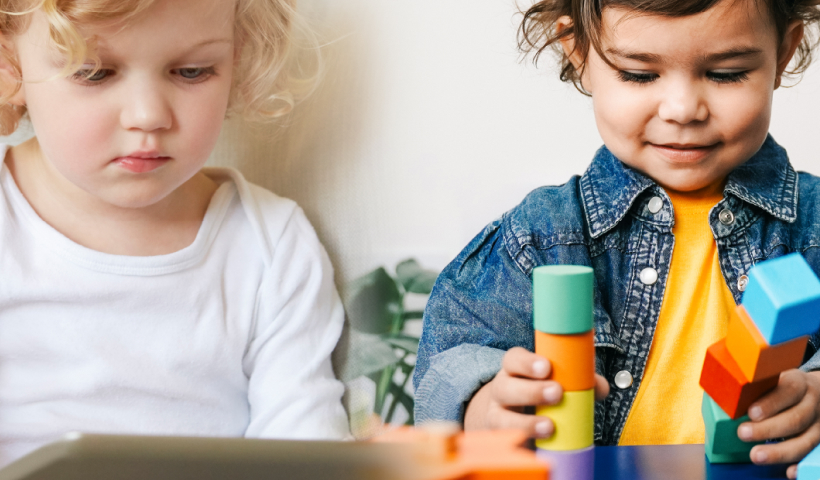
The importance of play and social interaction in children's holistic development, in contrast to the increasing use of screens. The stimulation provided by adults makes a significant difference in children's communicative, emotional, social, and cognitive development.
As healthcare professionals, what is your perspective on the changes in new generations, especially regarding access to screens?
The experience of working in a health context, specifically in pediatric consultation, allows us to see the undeniable change in the dynamics of behavior and social patterns on the part of children and their families, as well as the high impact that the use of screens generates on child development at the cognitive, communicative, emotional and social levels.
How can we expect anything different from children if the adults responsible for them offer an inadequate model and, moreover, do not offer different alternatives?
In the outpatient waiting room, we see families waiting to see a specialist, and each person, including the children, has an electronic device in their hands. It's not uncommon to see an adult holding a cell phone in front of a baby lying in their stroller. Children's songs play, and the screen constantly changes.
On the other hand, there's a different scene: a parent watching their child play, running noisily in search of another child, sometimes forming small play groups around a toy someone has brought from home. At the back of the room, a mother breastfeeds her child, talking to them, and at the small children's table, some little ones happily share their time coloring in their books.
What makes the difference between these two scenarios?
The physical context is the same. What makes the difference is definitely the stimulus offered by the adult.
Without aiming to create a radical censorship of screen use, we intend to encourage reflection on the matter and highlight the importance of proper social interaction and the use of toys for the development of skills and abilities in children.
What consequences can be observed from the increase in screen use?
The experience of recent years due to the Covid-19 pandemic and the imminent need for access to screens, especially to support educational processes, led to the establishment of behavioral patterns that have persisted beyond their relevance, to the detriment of activities that promote physical, communicative, emotional, and social development in children.
Given the significant increase in consultation rates for speech therapy, neurology, child psychology, and occupational therapy due to language, communication, attention, and behavioral disorders (increased aggression, tantrums, low frustration tolerance, social isolation, low empathy), a common factor is high exposure to screens and violent content in video games and television programs, which can desensitize children to violence and increase the occurrence of aggressive behaviors.
What does the evidence say about excessive screen use?
Increased screen time has been directly linked to difficulties in developing communication and social skills. According to Frontline Child Psychiatry (2024), excessive and compulsive use of digital media interferes with daily activities, social relationships, and psychosocial well-being, with clear withdrawal symptoms appearing when exposure ceases and an inability to control screen use. Similarly, it has been observed that in young children, traumatic situations generate biological responses that can induce the activation of hormonal systems involved in the stress response, as well as changes in the types of reactions in brain areas responsible for processing emotions, regulating mood, recalling and being aware of these emotions, and which can eventually affect attention and neurological activation.
If these situations persist, they lead to a state of disturbance or chronic stress that in turn generates well-known health difficulties such as overweight, difficulties in regulating sugar and cholesterol levels, immune failures, sleep disorders, and even structural changes (such as loss of size) in brain areas directly involved in memory and learning.
The consequences of such exposure to traumatic situations at an early age go even further, demonstrating that they can induce changes in the genetic information responsible for controlling behavior, early neurological development, and other factors. The exposure described includes not only harmful stimuli related to abuse or violence, but also situations related to persistent isolation and excessive screen time at an early age.
Is it possible to reverse these effects?
Yes. In situations where these types of factors are minimized or eliminated, it is possible to partially or permanently reverse the harmful changes.
The protective effect of situations such as physical contact with others, adult care for the child, regular sleep patterns and physical exercise, the creation of predictable routines that promote participation, the proper use of free time, and the activation of imagination and play is well demonstrated.
Why is social interaction important in language development?
As noted in BMC Public Health (2024), social interaction, contact with others, especially peers, and the opportunity to learn to interpret facial expressions are essential for early verbal language development. This is often restricted in situations such as passive screen time or the use of face masks.
What role does play play in children's learning?
Play is a natural expression of a child's activity, through which they learn more than through formal instruction, as they have the freedom to face new experiences and make mistakes. As María del Carmen Morón states, in play, children establish their own rhythms and control the situation; they are independent and confront the problems that arise, which is important for stimulating thinking. The adult's role is to mediate, guiding the child toward effective and meaningful play by providing the most stimulating situations and toys.
What are the benefits of playing with toys?
Playing with toys has important benefits for children's development. Among them we can mention:
- Stimulation of creativity. Promotes imagination by encouraging the creation of stories, situations, and scenarios.
- Physical development. Motor play helps develop both gross and fine motor skills, thus exercising the muscular system and promoting coordination.
- It exercises the maintenance of attention and the process of concentration on the stimulus, unlike what happens in front of a screen, which provides a highly striking and changing visual stimulus that generates confusion, rather than a real process of attention.
- Social interaction. It promotes social skills, which are vitally important in emotional and social development.
- Hands-on learning. Basic concepts of language, science, and mathematics are learned through play in a fun way.
- Unlike screens, toys do not pose a risk of sensory overload; rather, they promote a calmer and more controlled pace.
How does the use of toys contribute to language development?
Using toys in play activities promotes social interaction, conversation, and vocabulary development in children. When children use toys, especially in role-playing games, they often talk to each other or to themselves, which allows them to practice language rules, enrich their vocabulary, form sentences, and strengthen their ability to express their thoughts. Additionally, they generate questions and answers, propose actions and modifications, and assign roles, turns, consequences, and rewards.
By using a variety of toys, children are introduced to words related to objects, actions, relationships, and even concepts. Toys allow and encourage the creation of scenarios and stories, thus stimulating narrative skills.
Additionally, it fosters language comprehension and emotional expression. When playing, it's necessary to follow a series of steps that are often created and proposed by the participants themselves. Through play, children can express their emotions and feelings, which promotes the development of an increasingly broad emotional vocabulary.
What recommendations can adults follow regarding children's play?
Adults are encouraged to foster a healthy connection with children, spend quality time with them, and enrich their play options and toys according to their age and developmental level, offering alternatives to screens and promoting healthy overall development. Here is a brief list of recommended toys by age:
- 0 to 6 months. Mobiles with hanging toys. Toys with music or sounds, crib mobiles, rubber dolls, teethers. Fabric rugs or blankets. Rattles.
- 6 to 12 months. Teethers, toys with sound/movement, soft toys, textured balls, tactile and sound mats, activity centers, rolling toys, bath toys that float. Large soft animals, colorful and shaped stacking and nesting toys, large building blocks.
- 1 to 2 years. Stuffed animals, rolling toys, stacking toys, ring pyramids, balls, rocking toys, pull toys, and push toys. Plastic books for reading and playing in the bath, toys for use in the water and sand. Pedal-free tricycles, large ride-on vehicles, wooden, plastic, or foam stacking toys. Large, colorful blocks, and paints.
- 2 to 3 years. Cloth dolls, wooden or plastic stacking/fitting toys, water and sand toys, swings and slides, large ride-on vehicles, pedal tricycles, buckets and shovels, baby dolls, pretend play houses and costumes. Vehicles, 6-12 piece puzzles and EVA foam floor puzzles, sound toys, dominoes and bingo with pictures or photos of everyday life, drawing supplies.
- 3 to 5 years. Water/sand toys and objects, balls, skates and quad bikes, large pedal vehicles, two- or three-wheeled skateboards, bowling and ring toss sets, articulated dolls, pretend play sets, toy vehicles. Puppets, puzzles up to 50 pieces, stacking toys, modeling games, bingo and dominoes, books for painting, drawing, cutting and pasting, costumes, children's stories.
- 5 to 8 years. Spinning tops, kaleidoscopes, bicycles, skateboards and roller skates, balls, yo-yos, bowling sets, marbles, jump ropes, suction cup dartboards, rackets. Articulated dolls and play sets, toy racetracks, crafts, kitchen toys, 50-150 piece puzzles, wooden and brick architectural models, Native American houses, classic and strategic board games, card games, and science kits.
- 8 to 11 years. Spinning tops, bicycles and skateboards, balls, action figures and accessories, go-kart tracks, remote-controlled vehicles. Karaoke, tangram and 3D mosaics, puzzles up to 300 small pieces, model kits, mechanical and electrical assemblies, simple science experiments, scale model kits and origami, card games, classic and strategy board games.
- 11 to 14 years. Bicycles, skateboards, ping pong tables, paints and easels, model kits, puzzles up to 500 pieces, 3D models, and 3D mosaics. Assemblies with moving parts made from mechanisms or electrical circuits, assemblies of elements that allow for the reproduction of scientific experiments. Card games, games of chance, darts, classic board games of deduction, strategy, and simulation.
Why is it key to rescue play in childhood?
The importance of play in childhood is highlighted, and social interaction with both adults and other children is encouraged, remembering that these are fundamental elements in development and are key to learning processes, intellectual, social and emotional development by generating relationships with others, regulating behavior, taking turns, resolving conflicts and negotiations.
What is the conclusion regarding the use of toys and screens?
It is concluded that playing with various objects and toys is a highly beneficial strategy that should be taken into account.
Screens and mobile devices can be a viable alternative, but they should not replace interpersonal contact and the manipulation of toys. Given the risks posed by digital devices, the key is to develop habits that allow for a healthy balance, taking into account the need for adequate sleep, physical activity, and social interaction. Because we live in an era marked by constant exposure to screens, parents are called upon to take specific measures for their children regarding their use. These plans should consider each child's age, health, personality, and developmental stage.
Authors:

Dr. Viviana Silva (Speech Therapy)

Dr. Juan Fernando Gómez (Neuropediatrics)