



“Physical health is the first requirement for the well-being of body and mind.”
What is physical rehabilitation?
Rehabilitation is an essential medical specialty focused on restoring, maintaining, or improving the physical and functional abilities of people who have suffered injuries, undergone surgery, or suffer from chronic illnesses. Its main purpose is to restore independence, improve quality of life, and facilitate the patient's reintegration into their family, social, and work activities.
Rehabilitation begins even long before returning home with exercises during the hospital stay to prevent muscle weakness and improve functionality.
What can I do for rehabilitation at home?
Stimulating and promoting the development of essential activities in a person's daily routine, such as eating, bathing, dressing, and performing other simple tasks, is fundamental to achieving independence and promoting proper muscle function.
Learn about some recommendations on nutrition, personal hygiene, and other tools that help with rehabilitation at home:
- Article: Activities for daily life
Physical rehabilitation therapies
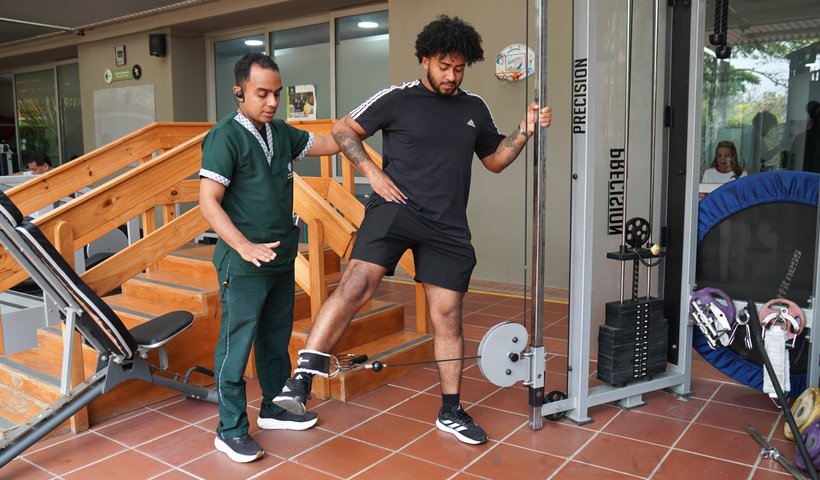
During your physical rehabilitation sessions at our facilities, it is very important that you keep in mind the recommendations to prevent falls and injuries:
The rehabilitation process utilizes various advanced therapeutic tools to precisely address each patient's needs; therefore, each session is individualized. Additionally, it is important to understand the exercise plan for the different muscle groups.
- Video: Exercise plan for strengthening the neck
- Video: Exercise plan for shoulder strengthening
- Video: Exercise plan for strengthening the lower back
- Video: Exercise plan for strengthening ankles
- Video: Exercise plan for strengthening the knees
How to strengthen the pelvic floor?
Strengthening your pelvic floor muscles prevents incontinence, improves sexual function, and provides greater stability to your body. Learn more here:
- Article: Urinary Disorders
- Article: Defecation Disorders
- Article: Home exercise plan – Pelvic floor
What can I do if I have neck pain?
Neck pain, or cervicalgia, is primarily caused by poor posture, a blow to the neck, an improper bite, or vision problems. This leads to tension in the neck muscles and restricts movement of the cervical vertebrae.
However, muscle tension and cervical vertebrae blockage are related to stress.
Specific rehabilitation plans and post-injury management
Distal Radius Fracture
A distal radius fracture is a break in the main bone of the forearm at its end closest to the wrist, and is one of the most common bone injuries caused by falls onto an outstretched hand.
Caring for your fracture at home:
- You can begin rehabilitation the next day by moving your fingers.
- Recovery from these fractures is usually achieved around day 45, so it is important to avoid any exertion during this period: do not push, do not pull, do not unload weight, and do not wring.
- It is also not recommended to use rubber balls to squeeze with your fingers; this prevents full mobility of the fingers and can cause additional damage.
- Gradually involve the affected arm in self-care activities that do not require additional effort or cause pain: bathing, dressing, eating.
Recovery can take 2 to 3 months, depending on factors such as age, other illnesses, daily activities, and commitment to rehabilitation, attending therapies and properly following the home plan.
Hygiene and self-care recommendations
- If you have wounds or skin lesions, do not apply any cream; this may delay the healing process.
- Keep the scar covered to avoid damage caused by sunlight and artificial light, as this can cause spots or keloid scarring.
- Avoid exposure to extreme temperatures (heat or cold) without prior guidance from healthcare personnel.
- Elevate the limb by opening and closing your hand to promote blood flow and prevent swelling; try not to keep your hand hanging down for long periods of time.
Work activity and exercise
Please note that full recovery will take at least a year.
- You will likely be able to resume activities such as swimming or lower body exercises two months after surgery. Activities such as playing soccer or other contact sports can be resumed six months after surgery.
- You may experience occasional pain during the first year; however, it should not be severe or persistent. If any activity causes severe pain, you should stop it and consult your doctor.
- Avoid lifting heavy loads and repetitive activities that put strain on your wrist joint. Take active breaks of approximately 10 minutes every two hours to give the joint a rest.
- You may experience stiffness or mild, even persistent, pain. This occurs in high-energy injuries (motorcycle accidents), in patients over 50 years of age, or in patients with osteoarthritis. This should not affect overall arm function.
- Remember that the force you apply to your arm should be progressive and always mediated by the intensity of the pain: for the first 6 months avoid doing planks on your wrists or forearms.
- Return to the gym only when your doctor says it's okay. Follow their recommendations regarding the load or intensity you can handle.
Related content:
Ankle sprain
An ankle sprain is an injury to the ligaments (flexible structures that connect bones to each other) caused by a sudden, forceful movement. It is characterized by pain, swelling, and limited mobility.
Rating:
- Grade I: Less than 5% fiber breakage
- Grade II: 40-50% fiber rupture
- Grade III: Complete ligament rupture.
Care:
The care will depend on the severity of the sprain:
Grade I sprain:
- Elevate the affected leg when lying down or sitting.
- Apply ice wrapped in a towel for 10 minutes, every 3 hours.
Grade II and III sprains:
- Do not put full weight on your foot until your doctor tells you it is safe to do so.
- Use crutches properly.
- Elevate your leg constantly throughout the day.
- When going to sleep, place a pillow under your leg to elevate it.
Activities at home:
- During the immobilization period, do not perform activities that require prolonged standing, such as sweeping, mopping, or cleaning.
- When working remotely, watching television, or in prolonged positions, use a stool to elevate the affected leg.
- Do not perform exercises that involve standing on one leg until your treating physiotherapist advises you to do so.
Hygiene and self-care
- Sit down to brush your teeth, shave, put on makeup, and style your hair.
- If needed, ask for help bathing or do it sitting down.
Patellofemoral Syndrome
Patellofemoral pain syndrome is a joint disorder that causes pain in the front of the knee, around or behind the kneecap. This symptom often worsens when going up or down stairs, bending over, or sitting for extended periods.
Related content:
Rotator Cuff Injury
The rotator cuff is a set of four tendons (tissues that connect muscle to bone) that surround the shoulder joint. Its main function is to allow the shoulder to rotate and move in different directions. An injury occurs when these tendons become irritated, worn down, or torn.
- Avoid constant overhead movements.
- Avoid carrying heavy objects: flowerpots, market bags, suitcases.
- Take breaks when performing repetitive activities.
- Keep personal items within easy reach to avoid movements or efforts that increase strength and strain on the shoulder.
- DO NOT carry the briefcase or bag on only one shoulder.
Hygiene and self-care
- When sleeping, lie on your back and rest your sore shoulder on a couple of pillows to avoid strain.
- When lying on your side, prefer to do so on your healthy side and place a pillow in the armpit area, allowing the arm to remain slightly open.
- When sitting, keep your head above your shoulder and place a towel or pillow behind your lower back. Keep your feet flat on the floor or on a footrest, and ensure your shoulders are not tense or raised.
- Perform the indicated exercises at least twice a day.
Performance of household activities
- Use items that make household chores easier: washing, hanging clothes to dry.
- Ask for help if you need it.
- Avoid carrying very heavy market bags with only one hand.
- Avoid repetitive activities above shoulder height.
Related content: