

Endoscopy
What does this specialty do?
The Endoscopy Service of the Fundación Valle del Lili It offers specialized medical care with high standards of quality, safety, and diagnostic accuracy. It features state-of-the-art technology and a highly trained and dedicated team of patients.
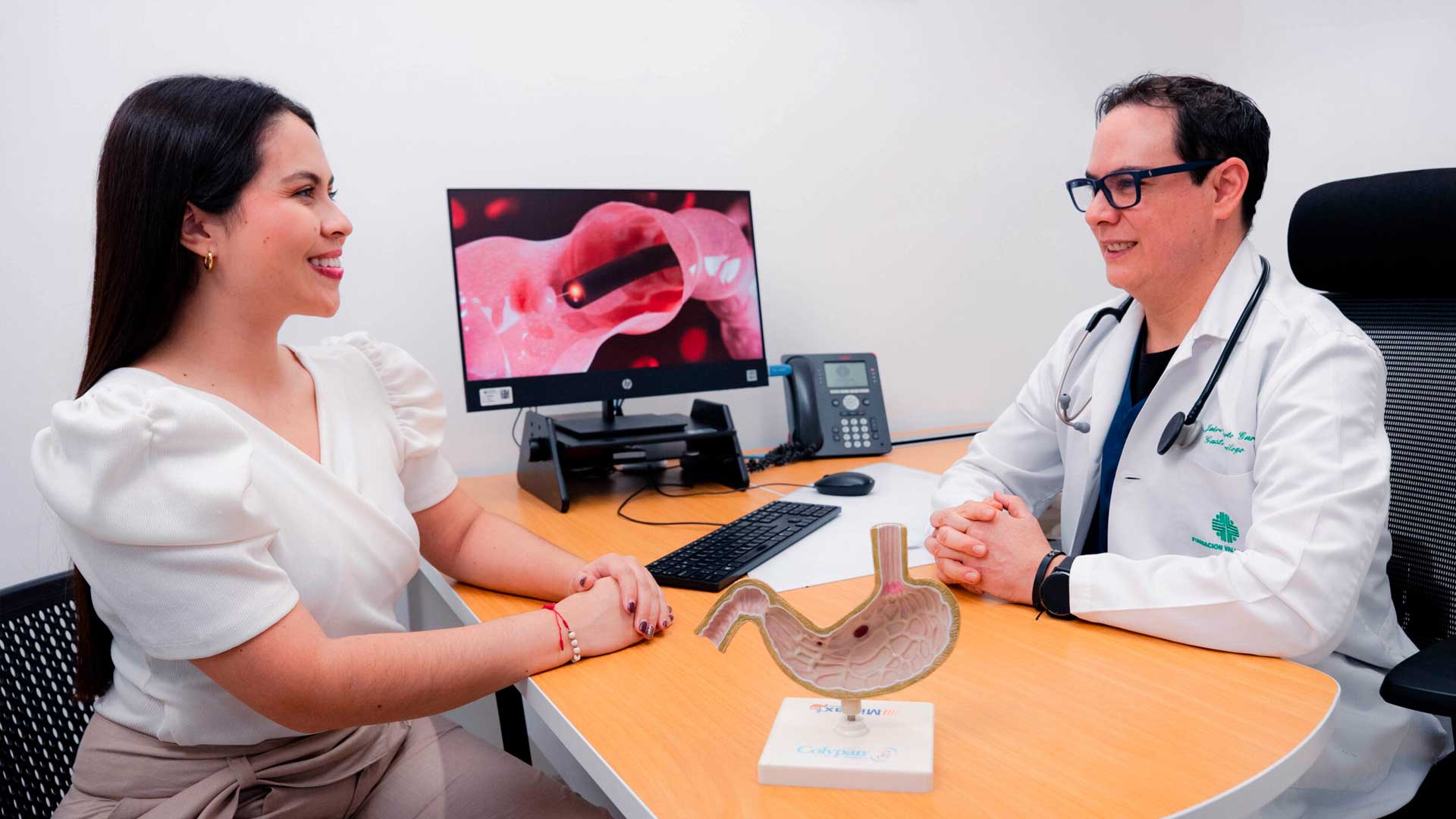
Minimally invasive diagnostic and therapeutic procedures are performed, allowing direct visualization of the digestive, respiratory, and genitourinary tracts, enabling early disease detection and precise management. Care is provided to both adult and pediatric patients, with options for conscious sedation or general anesthesia, depending on the case.
Diseases it treats
The service addresses a wide range of hormonal and metabolic disorders, offering personalized, high-quality care. Conditions treated include:
- Type 1, type 2 and gestational diabetes mellitus.
- Thyroid diseases: hypothyroidism, hyperthyroidism, goiter, nodules and thyroid cancer.
- Obesity and overweight.
- Osteoporosis and disorders of calcium metabolism.
- Pituitary gland diseases: tumors, acromegaly, prolactinomas.
- Adrenal disorders: Cushing's syndrome and adrenal insufficiency.
- Dyslipidemias (alterations of cholesterol and triglycerides).
- Calcium and phosphorus imbalances due to parathyroid diseases.
- Hypogonadism (sex hormone deficiency).
Procedures or treatments
Services range from conventional procedures to advanced techniques in various specialties.
Gastroenterology
- Upper digestive endoscopy: It allows visualization of the esophagus, stomach, and duodenum. It is indicated in cases of abdominal pain, persistent nausea, difficulty swallowing, gastrointestinal bleeding, or suspected ulcers, severe reflux, or cancer. It may include taking biopsies.
- Total colonoscopy: It visualizes the colon and rectum, useful for the detection and prevention of colon cancer. It allows for the identification of polyps, inflammation, or bleeding, and enables resections or biopsies to be performed.
- Sigmoidoscopy: examination of the rectum and sigmoid colon.
- Percutaneous endoscopic gastrostomy: placement of a feeding tube in the stomach for patients who cannot feed orally.
- Breath test for Helicobacter pylori: non-invasive test that detects this bacteria that causes gastritis and ulcers.
- Endoscopic retrograde cholangiography (ERCP): It combines endoscopy and fluoroscopy to diagnose and treat blockages, stones, or tumors in the bile and pancreatic ducts.
- Lithotripsy of stones in the biliopancreatic duct: It fragments large stones to facilitate their removal without surgery.
- Cholangioscopy: direct visualization of the bile and pancreatic ducts for diagnosis, biopsy, or treatment.
- Video capsule endoscopy: A capsule with a camera that travels through the small intestine, useful for detecting hidden bleeding, inflammation, or tumors.
- Enteroscopy: examination of the small intestine orally or rectally for diagnosis and treatment of complex diseases.
- Endoscopic resection of submucosal lesions: removal of superficial precancerous tumors without open surgery.
- Dilations and stent insertion: treatment of obstructions using endoscopic prostheses.
- Biliopancreatic endoscopic ultrasound: evaluation of the pancreas, gallbladder and bile ducts with endoscopic ultrasound.
- Endoscopic ultrasound of the esophagus, stomach, duodenum and rectum: It allows for detailed visualization and guided biopsies.
Coloproctology
- Total colonoscopy: Colon and rectal examination for cancer diagnosis and prevention.
- Sigmoidoscopy: evaluation of the sigmoid colon and rectum.
- Hemorrhoid ligation: minimally invasive treatment using elastic bands that interrupt blood flow.
Digestive physiology
- Esophageal manometry: It evaluates the function of the esophageal muscles during swallowing.
- Anorectal manometry: It analyzes the function of the muscles of the rectum and anus.
- pH monitoring with or without impedance monitoring: It measures the acidity in the esophagus for 24 hours to diagnose gastroesophageal reflux.
Urology
- Cystoscopy: It allows observation of the urethra and bladder with the possibility of biopsies.
- Steam therapy for benign prostatic hyperplasia: It reduces prostate size and improves urinary symptoms.
- Uroflowmetry: evaluates the speed and volume of urinary flow.
- Urodynamics: It studies the functioning of the bladder and urethra through pressure measurements.
- Videourodynamics: It combines urodynamic study with real-time imaging.
Pneumology
- Bronchoscopy with bronchial washing: visualization of bronchi and sampling.
- Endoscopic ultrasound of the trachea, bronchi and mediastinum (EBUS): It combines bronchoscopy and ultrasound for the diagnosis of lung cancer, infections or mediastinal diseases, with the option of biopsy.
- Resection or ablation of lesions in the trachea and bronchi: removal of tumors or obstructions using techniques such as laser or radiofrequency.
Otolaryngology
- Fiberoptic nasolaryngoscopy: examination of the nose, throat and larynx using a flexible endoscope.
- Nasosinuscopy: diagnosis of sinusitis, polyps or tumors in the paranasal sinuses.
- Endoscopic evaluation of swallowing: Observation of the swallowing process for the diagnosis of dysphagia.
Head and neck surgery
- Fiberoptic nasolaryngoscopy: used for pre- and post-operative assessment in airway surgeries.
Gynecology
- Colposcopy: It allows observation of the cervix, vagina and vulva to detect precancerous lesions or cancer.
- Conization: removal of a portion of the cervix when abnormal cells are identified.
Exam preparation
| Endoscopy | Preparation for resection of a submucosal colonic tumor | Download |
| Endoscopy | Preparation for gastric polypectomy or mucosectomy | Download |
| Endoscopy | Preparation for polypectomy or mucosectomy of the colon tomorrow | Download |
| Endoscopy | Enteroscopy Preparation | Download |
| Endoscopy | Preparation for upper digestive tract endoscopy | Download |
| Endoscopy | General care after – Endoscopic submucosal resection | Download |
| Endoscopy | Post-operative recommendations – Endoscopic esophageal variceal ligation | Download |
| Endoscopy | Esophageal Manometry Preparation | Download |
| Endoscopy | Post-Ceper Recommendations | Download |
| Endoscopy | Post-colon polypectomy recommendations | Download |
| Endoscopy | Post-gastric polypectomy recommendations | Download |
| Endoscopy | Total Colonoscopy Preparation: Morning Schedule | Download |
| Endoscopy | Total Colonoscopy Preparation Scheduled for the Afternoon | Download |
| Endoscopy | Standard Urodynamics Preparation | Download |
| Endoscopy | Videourodynamics Preparation | Download |
| Endoscopy | Uroflowmetry Preparation | Download |
| Endoscopy | Breath Test for Helicobacter Pylori Detection | Download |
Schedule an appointment
Request your appointment with our endoscopy specialists.
Contact
Call us: (+57) 602 331 9090 Ext. 7454
WhatsApp: 321 799 7546